
Why the slab matters
Many newer neighborhoods around McDonough, Stockbridge, Hampton, Fayetteville and Newnan sit on gentler ground than the steep lots north of the city. That makes slab-on-grade construction common, where the ground floor is a concrete slab poured directly on prepared soil. Crawlspaces are common too, so check yours rather than assume. In a slab house, every first-floor room has concrete a pad's thickness under your feet.
That changes the flooring choice in three ways: moisture can rise through the concrete, the concrete has to be flat enough for the new floor, and nothing can be nailed into it the way it can into plywood.
Moisture from below
Concrete is porous. Ground moisture moves up through a slab and out at the surface, slowly in a well-built house with a vapor retarder under the slab and faster in one without. Carpet and pad let that moisture escape into the room. A hard floor glued or floated over the slab traps it underneath, where it can break down adhesive, warp wood or grow mildew.
So the slab gets tested before a hard floor goes down. Flooring makers name the test they accept, usually an in-slab relative humidity test or a calcium chloride test, and set a maximum reading for warranty coverage. In a house only a year or two old, the slab may still be drying out. Ask the installer which test they use and get the result in writing.
Flatness and cracks
Carpet hides a lot of uneven concrete. Vinyl plank, laminate, engineered wood and tile do not. Most installation instructions give a flatness limit over a set distance, and humps or dips beyond it have to be ground down or filled with a patching or self-leveling compound. That prep is easy to leave out of a quote, so ask whether it is included.
Look at the slab when the carpet comes up. Thin shrinkage cracks are normal. Tile is the floor least tolerant of them; a crack isolation membrane under the tile is the usual fix. The hard flooring section of the measuring guide covers prep and waste allowances.
Builder carpet over concrete
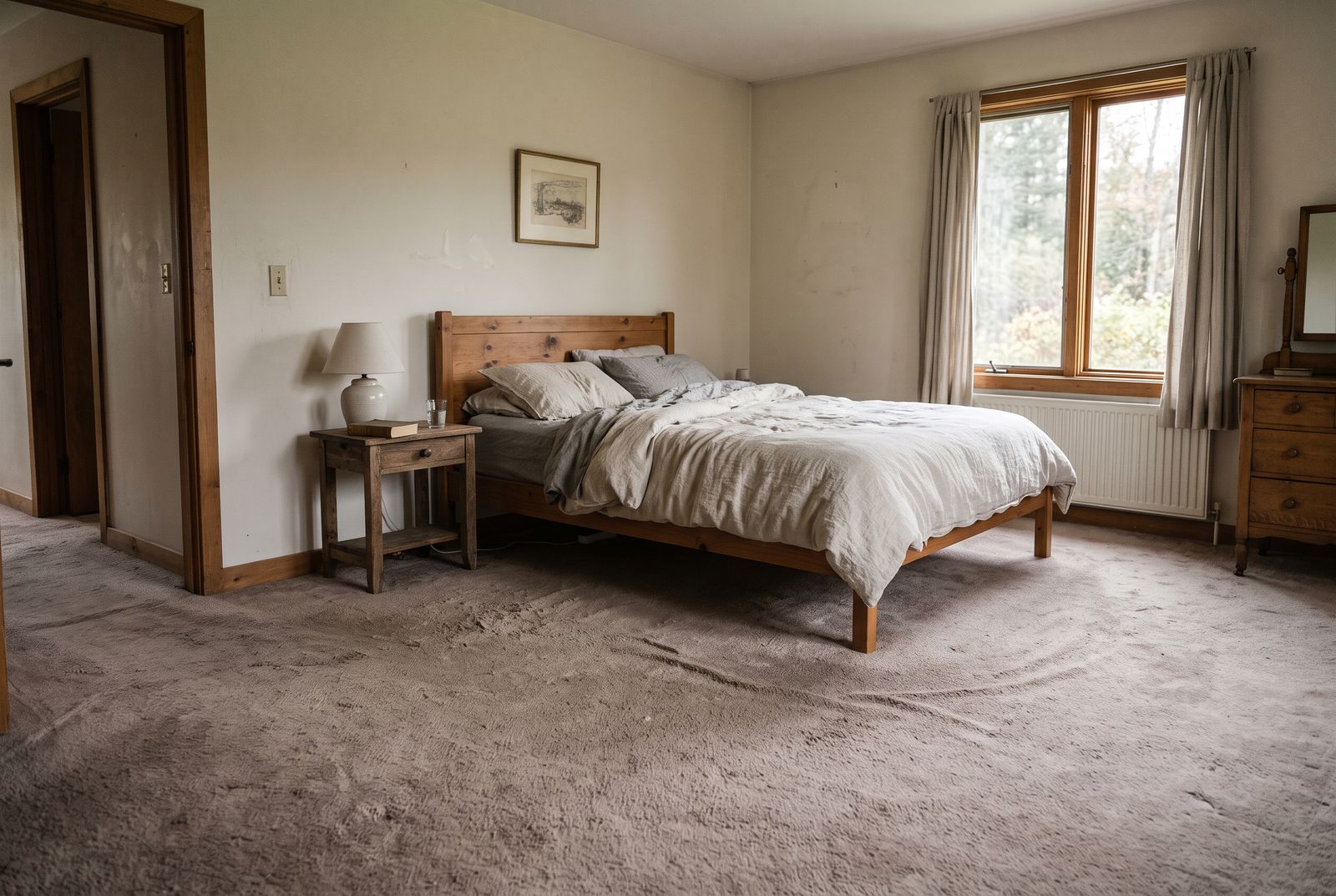
In many of these homes the original carpet and a thin pad went straight onto the slab. On concrete, a thin pad wears out quickly, and the carpet over it shows lanes early. If you are staying with carpet, a better pad makes a noticeable difference in feel and in how long the next carpet lasts. Choose one rated for use on concrete, and check what the carpet maker requires for its warranty.
When the old carpet comes out, the tack strip comes with it, nailed into the concrete around the room. Pulling it can chip the slab edge, which matters if the next floor is hard. The tear-out section explains what to expect.
What works on a slab
| Floor | How it goes down | What to check first |
|---|---|---|
| Carpet | Tack strip at the walls, pad over the slab | A pad suited to concrete; any musty smell from below |
| Vinyl plank | Floating or glue-down | Flatness, and moisture limits for glue-down |
| Engineered wood | Glue-down or floating | Moisture test, flatness, a vapor barrier if floated |
| Porcelain or ceramic tile | Thinset directly on the slab | Cracks, flatness, a membrane where needed |
| Solid hardwood | Needs a plywood subfloor over the slab | Raised floor height at doors and transitions |
Peachtree City and older areas
Not everything south of the city is new. Peachtree City was planned and built out over several decades from the 1960s, and its older streets have houses on crawlspaces and basements as well as slabs. Older parts of Clayton County and the towns along the old rail lines also have houses that predate the subdivisions. If your house is one of these, the intown Atlanta guide on crawlspaces and older wood floors will fit it better than this page.
Questions
Can hardwood go on a concrete slab?
Solid hardwood is generally not nailed directly to concrete. Engineered hardwood made for glue-down or floating installation is the usual way to get real wood on a slab, as long as the slab passes the moisture test the manufacturer requires.
Are cracks in my slab a problem for new flooring?
Thin cracks from concrete shrinkage are common and usually harmless under carpet or floating vinyl plank. They matter more for tile, which can crack along them unless a crack isolation membrane is used. Cracks that are wide, growing or offset in height are worth having checked before any floor goes down.