
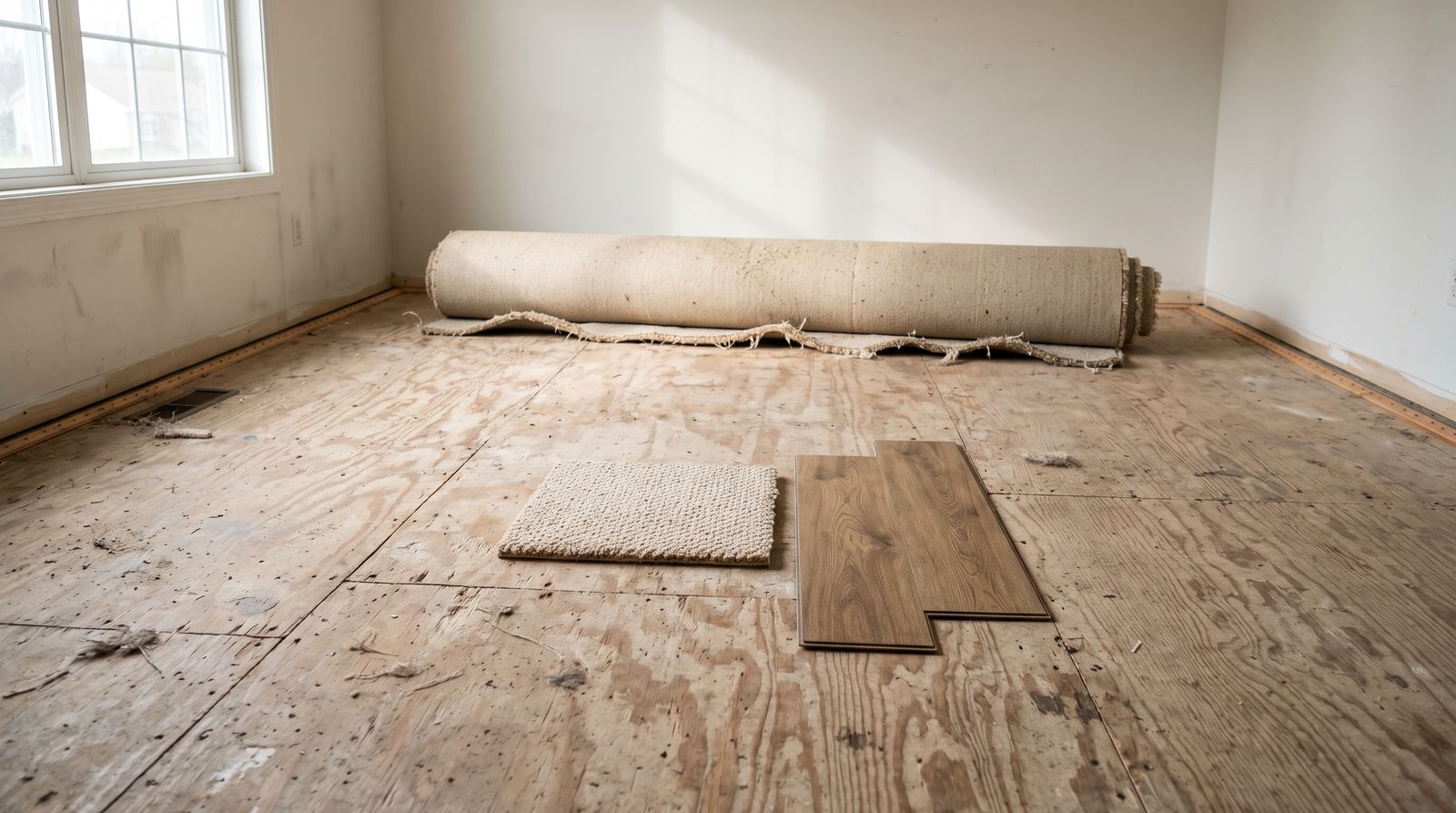
What is usually under the carpet
Much of the housing in places like Inman Park, Grant Park, West End, Kirkwood, Virginia-Highland and Decatur's Oakhurst and Winnona Park went up between the 1890s and the 1940s, when solid wood was the standard floor. Wall-to-wall carpet arrived decades later, typically laid straight over those boards. So when intown homeowners pull up a corner, they very often find wood.
Two kinds turn up most. The older Victorians tend to have wide heart pine, cut from old-growth longleaf pine, with a deep orange-brown color that darkens with age. Bungalows from the 1910s through the 1930s more often have narrow oak strip flooring. Both can usually be sanded and refinished, but each comes with the marks of its carpet years: rows of tack strip nail holes around the walls, thousands of pad staples, paint drips from past makeovers, and dark stains where a radiator, a plant or a pet sat for years.
The deciding detail is thickness. Every full sanding removes wood, and a floor that was refinished several times before the carpet went down may be close to its tongue. Ask a refinisher to check before you commit, and if part of the house has plywood or a different species where a wall was moved or a bathroom expanded, plan on patching or on covering that room. For the pros and cons of keeping carpet in some rooms anyway, the room by room comparison is the place to start.
Crawlspaces and summer cupping
Most of these houses sit over a vented crawlspace rather than a slab or basement. In an Atlanta summer, the air moving through those vents is warm and humid, and it meets the cooler underside of an air-conditioned floor. Moisture collects, the bottoms of the boards swell more than the tops, and the floor starts to cup: the edges of each board rise above its center.
Before you refinish, install new hardwood or lay a floating floor, look in the crawlspace or have it inspected. Things to check:
- Is there a plastic vapor barrier covering the soil, and is it intact?
- Any standing water, wet soil or white mineral deposits on the piers after rain?
- Do downspouts drain away from the house, or straight against the foundation?
- Is there mold on the subfloor or joists, or insulation hanging loose and wet?
If the answer to any of these is yes, fix the moisture first. Sealing or encapsulating a crawlspace is its own project with its own trade-offs, and it should be designed by someone who works on crawlspaces. New flooring installed over a damp crawlspace inherits the problem.
Old floors are rarely flat
A hundred years of settling, sagging joists and old repairs mean intown floors often slope or dip. Carpet hides this; hard flooring shows it. Floating vinyl plank and laminate need a flat base, and most manufacturers publish a flatness tolerance in their installation instructions. Over a wavy old floor, planks can flex at the low spots and the click joints can fail.
Fixes range from screwing down squeaky boards and sanding high spots to adding a plywood underlayment, or sistering sagging joists from the crawlspace. Underlayment raises the floor, which matters in these houses: old doors, the transition to a small tiled bathroom, and the first stair tread all sit at fixed heights. The measuring guide covers how transitions and thresholds affect the material list.
Painted trim and pre-1978 rules
Removing carpet is simple. Replacing it with a hard floor often means pulling off shoe molding or baseboard, and in a house built before 1978 that trim is likely to carry old lead paint under newer coats. Under the federal EPA renovation rule, contractors paid to disturb painted surfaces in pre-1978 homes must be lead-safe certified and follow its work practices. Ask any installer whether they are certified before trim comes off.
Narrow stairs and tight streets
Intown logistics are their own small project. Many bungalows have a steep, narrow stair to a converted attic, where carpet still gives the best grip and a full roll may not make the turn. Street parking is tight in many neighborhoods, and a dumpster on the street rather than in the driveway may need city permission. Ask the installer how they will get material in and old carpet out; the removal and disposal guide lists the questions.
Choosing what goes down
- If the original wood is thick enough and the crawlspace is dryrefinish it and use rugs for warmth and sound in bedrooms.
- If the wood is too thin or badly patchedconsider new carpet or a floor over plywood underlayment, and leave the old boards in place underneath.
- If the crawlspace is dampdeal with it first; then choose the floor.
- If the upstairs is a converted attic with a steep staircarpet on the stair and upper floor is usually the safer, quieter choice.
Questions
Is it worth refinishing the wood I found under my carpet?
Often, yes, but only after someone checks how much wood is left above the tongue. Pull a floor register or look at a board end in a closet. Boards that have been sanded several times, or that have pet damage soaked deep into the grain, may need patching or replacement in places. A refinisher can tell you in person whether a full sand is safe.
Do Atlanta or Decatur historic district rules cover flooring?
Local historic district review generally deals with the outside of a house, such as siding, windows, porches and additions, not interior finishes. Rules and boundaries differ between the City of Atlanta and the City of Decatur, so check with the city if your project touches anything visible from the street, including where a dumpster will sit.