
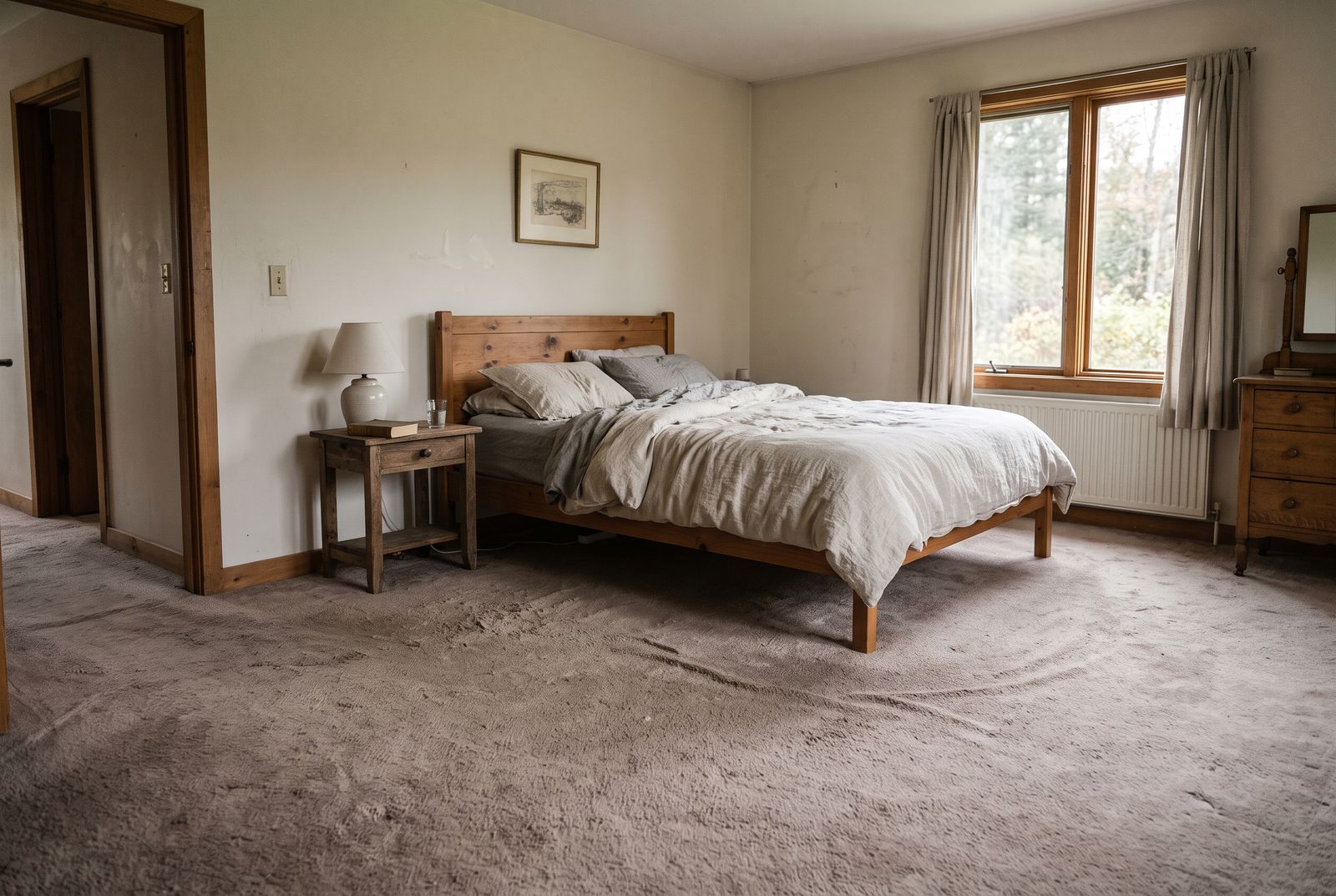
Signs that cleaning will not fix
Cleaning removes soil from the face of the carpet. It cannot rebuild fiber that has been crushed flat, re-attach backing that has let go, or pull odor out of a pad that has absorbed it. So the useful question is not "does it look bad?" but "where is the problem?" Each sign below points to a layer.
The pile: matting, crushing and bald spots
Cut pile carpet is made of tufts of twisted yarn. Over years of foot traffic, the twist relaxes and the tufts splay and lie down, which is why hallways and the path from the sofa to the kitchen go dull first. Dull lanes that brighten after extraction were dirty. Lanes that look flat again a week later are worn. Once you can see the backing on stair noses or in a doorway, the face fiber is simply gone.
The backing: ripples that keep coming back
Wall-to-wall carpet is held tight on tack strip around the room. Ripples mean it has loosened. If an installer re-stretches it with a power stretcher and the waves return within months, the cause is usually deeper: a pad that has broken down, or a backing that is starting to delaminate, where the secondary backing separates from the primary one. Stretching cannot fix a backing that is coming apart.
The pad and subfloor: odor and wicking
Pet urine, spilled drinks and leaks soak straight through carpet into the pad, and sometimes into the subfloor. Surface cleaning can make the room smell fine for a day; then humidity rises and the odor returns. Stains that reappear after the carpet dries are a related symptom called wicking: moisture pulls residue up from below as it evaporates.
Pull back a corner of carpet in a closet with pliers and look at the pad. Crumbling foam, dark stains, a damp feel or a sharp ammonia smell tells you more than the carpet surface ever will. Press the corner back onto the tack strip when you are done.
Water damage
The water damage restoration standard most US restorers work to, IICRC S500, sorts water by contamination. Clean water from a supply line caught early can often be dried in place. Carpet and pad soaked by sewage or floodwater are generally removed, and anything that sat wet long enough to grow mold is in the same category. If water was involved, get that assessment first; it decides the rest.
Atlanta wear: red clay, humidity and pollen
Carpet in Atlanta homes tends to fail in a few predictable local ways, and it helps to tell them apart from ordinary wear before deciding anything.
Red clay stains
Georgia red clay is colored by iron oxides, so a clay mark behaves more like a rust stain than a food spill. Ordinary spotters and scrubbing tend to spread it and push it deeper. Let tracked-in clay dry, vacuum out as much as you can, then blot rather than rub. A professional cleaner may have a treatment meant for iron or clay stains, but those products can affect some fibers and dyes, so ask them to test it in a closet first. If an entry or back-door path is stained orange after professional cleaning, that area is a good candidate for a hard floor even if the rest of the carpet has years left.
Odor that comes back on humid days
A room that smells fine in January and musty in July is telling you something about the pad. Atlanta summers are humid, and moisture in the air revives odor from pet accidents or old spills that soaked into the pad and subfloor. In basements and slab rooms, the smell can also come from moisture moving up through the concrete. Cleaning the surface again will not change either one; check the pad as described above, and in below-grade rooms ask about a moisture test before choosing the next floor.
Pollen season
The yellow-green pine and oak pollen that blankets Atlanta each spring settles into carpet near open windows and doors. It vacuums out, so it is not a reason to replace carpet on its own. But if someone in the house has bad spring allergies and the carpet is already worn, it can be the deciding factor toward hard floors with washable rugs.
Why age alone is a poor guide
You will see carpet lifespans quoted as a range of years. Treat them as loose averages at best. Two carpets bought the same day can be at opposite ends of their life a decade later, depending on a handful of factors.
| Fiber | How it tends to age | What usually ends its life |
|---|---|---|
| Nylon | Springs back well from crushing, which is why it is common in busy homes. | Traffic lanes eventually, or stains if it lacked good stain protection. |
| Polyester (PET) | Holds color well and resists many water-based stains; soft when new. | Crushing and matting in high traffic areas. |
| Olefin (polypropylene) | Shrugs off moisture and fading; common in loop and berber styles. | Crushing, and oily soil that is hard to release. |
| Wool | Naturally resilient and hides soil well. | Damage from the wrong cleaning chemistry, moths, or prolonged moisture. |
Construction matters as much as fiber. Denser pile, where the tufts are packed closer together, holds up better than tall, loose pile that feels plush in the showroom. Tightly twisted yarn resists untwisting. And the pad does a lot of quiet work: a thin or low-density pad lets the carpet flex too much with every step, which speeds up wear on the backing.
Replace or keep: the eight-question check
Answer what you can. Some answers count more than others, and three of them point to replacement on their own.
- Traffic lanes stay flat and dull even right after a professional hot water extraction.
- Ripples or wrinkles came back after the carpet was re-stretched.
- An odor (pet urine, smoke, mildew) returns within days of cleaning.
- You can see backing or bald spots in walkways or on stair noses.
- Stains that were cleaned reappear once the carpet dries.
- The carpet or pad was soaked by floodwater, sewage or a leak that ran for days.
- Seams are opening or edges are fraying in more than one place.
- The room has changed use (new pets, a basement remodel, a home office) and carpet no longer suits it.
Answer a few more
Answer at least three questions for a read on your carpet.
When a repair is the better call
Replacement is not the only answer when damage is local. A good carpet repair technician can do a surprising amount, and it is far cheaper than new floors. These repairs are worth asking about first:
- Re-stretching. If the carpet was never stretched properly at install (knee-kicked instead of power-stretched), a proper stretch can remove ripples for good.
- Patching. A burn, pet scratch or permanent stain in one spot can be cut out and replaced with a piece from a closet or a saved remnant, using seaming tape. Matching pile direction is the skill.
- Seam and edge repair. Seams that have opened can be re-bonded; frayed edges at transitions can be trimmed and re-tucked or fitted with a new transition strip.
- Re-wrapping a stair. One worn stair nose can sometimes be shifted or replaced without touching the rest of the run.
- If the damage is in one spot and you have matching remnantpatch it and move on.
- If ripples appeared after a poor install, and the pad is soundpower-stretch it once.
- If ripples return after a proper stretchthe pad or backing is failing: replace.
- If odor lives in the pad across a roomreplace carpet and pad, and seal or treat the subfloor.
- If the room's use has changedcompare hard floors before buying carpet again.
Replacing one room or the whole floor
Doing one room at a time spreads the cost, but plan the edges. New carpet rarely matches old carpet next to it, even in the "same" style, because color varies between dye lots and the old carpet has faded and worn. Where two rooms meet in a doorway, a transition strip makes the change look intentional. Where one carpet runs continuously from a hallway into bedrooms, replacing only part of it leaves a seam in the open where the new and old meet.
Switching only some rooms to a hard floor brings a different question: height. Carpet and pad together are often thicker than a floating vinyl plank, so plan the transitions and check whether doors will need trimming or will clear. The measuring guide covers transitions in more detail.
The best time to decide what replaces the carpet is before anyone pulls it up.
Timing the replacement
A few sequencing choices save a lot of frustration:
- Paint first. Painting walls before new flooring goes in means drips land on old carpet or drop cloths. Baseboard touch-ups can wait until after.
- Fix the cause first. If a pet is still having accidents, a leak is not repaired, or a basement takes on water, new carpet will be the next casualty.
- Before listing a home. Worn carpet shows in listing photos and at showings. Talk to the listing agent about whether to replace, and with what, before spending.
- Leave room in the schedule. Hard floors sometimes need subfloor leveling, and some products call for acclimation time in the house before install. Ask what the product's instructions require.
When you have a sense of which rooms are due, the next step is choosing what goes down in each. That is the job of the carpet vs. hard flooring comparison.
Questions about replacing carpet
How many years should carpet last?
There is no honest single number. Fiber, pile density, the pad, traffic, pets and cleaning habits matter more than the calendar. A dense nylon carpet in a guest room can outlast a light polyester in a family room by many years. Judge the carpet by the signs on this page, not its age.
Can matted traffic lanes be brought back?
Light matting from soil often lifts after hot water extraction and grooming with a pile rake. Pile that has been crushed and untwisted over years does not recover, because the fiber itself has lost its shape. If lanes look flat again within a week of cleaning, it is wear, not dirt.
Is it worth replacing only the pad?
Rarely. Pulling carpet off the tack strip to swap the pad, then re-stretching and re-seaming it, takes much of the labor of a new install, and older carpet does not always survive being lifted and stretched again. It can make sense when carpet is fairly new and a single area of pad failed.
Do I have to replace carpet after a leak?
It depends on what kind of water it was and how long it sat. Clean water caught quickly can often be dried in place. Carpet and pad soaked by sewage, floodwater, or water that sat long enough to grow mold are generally removed. A water damage professional can assess it before you decide.