
Room explorer
Choose a room. Each floor gets a plain verdict and the reason behind it.
Carpet
StrongWarm underfoot first thing in the morning and quiet for the room below.
Vinyl plank
StrongEasy to keep clean for pets and allergies; add a rug by the bed.
Hardwood
StrongLow traffic means finishes last; sound can carry to rooms below.
Tile
WeakCold and hard where people walk barefoot.
Bottom line for the bedroom: Carpet is still the default here, and for good reason. Go hard if allergies or pet accidents are the deciding issue.
Carpet
WorkableComfortable and quiet, but takes the most traffic and the most spills.
Vinyl plank
StrongHandles traffic, kids and pets; pair with an area rug for comfort.
Hardwood
StrongThe classic look and can be refinished; a rug protects the seating area.
Tile
WorkableDurable, but hard and echoey in a room meant for lounging.
Bottom line for the living room: A hard floor with a large area rug gives the most flexibility. Choose carpet if this is a quiet adults-only room.
Carpet
AvoidGrease, water and food spills go straight into the pad.
Vinyl plank
StrongSpill tolerant and softer underfoot than tile for long cooking sessions.
Hardwood
WorkableFine with quick wipe-ups; a dishwasher leak is its worst enemy.
Tile
StrongNearly indestructible; hard on dropped glasses and tired feet.
Bottom line for the kitchen: Tile or vinyl plank. Wood works for careful households who wipe up quickly.
Carpet
AvoidConstant humidity and splashes lead to odor and mold.
Vinyl plank
StrongA waterproof plank works if edges at the tub and toilet are sealed.
Hardwood
AvoidStanding water and steam cause cupping and finish failure.
Tile
StrongThe standard choice; porcelain with a textured face for grip.
Bottom line for the bathroom: Tile first, waterproof vinyl second. Leave carpet and wood out of wet rooms.
Carpet
AvoidGrit and wet shoes wear and stain it fast.
Vinyl plank
StrongWipes clean; grit can still scratch the wear layer, so add a mat.
Hardwood
WorkableLooks great, but grit scratches it and wet shoes mark the finish.
Tile
StrongTakes grit, red clay and water without complaint.
Bottom line for the entry: Hard floor plus a washable mat inside the door. The mat protects every room beyond it.
Carpet
StrongBest grip, softer if someone slips, and quieter.
Vinyl plank
WorkableNeeds a stair nose on every step; more labor than flat floors.
Hardwood
StrongHandsome and durable; slippery in socks without a runner.
Tile
AvoidHard, slippery edges and rarely practical on residential stairs.
Bottom line for the stairs: Carpet or wood with a runner. Ask how the stair nose will be finished before choosing a hard floor.
Carpet
WorkableOnly over a dry slab, with synthetic fiber and a moisture tolerant pad.
Vinyl plank
StrongWaterproof cores tolerate damp concrete better than anything soft.
Hardwood
AvoidSolid wood and slab moisture do not mix; some engineered wood is rated for it.
Tile
StrongUnaffected by moisture, but cold on a slab without radiant heat.
Bottom line for the basement: Test the slab for moisture first. Vinyl plank or tile are the safe defaults below grade.
Carpet
WorkableRolling chair casters crush a ring into the pile; use a chair mat.
Vinyl plank
StrongChairs roll easily and the surface takes it.
Hardwood
StrongUse a mat or soft casters to avoid scuffs and dents.
Tile
WorkableDurable, but cold and loud for a room you sit in all day.
Bottom line for the home office: Vinyl plank or wood, with a chair mat. Carpet is fine if you are happy to use a mat too.
The materials, plainly
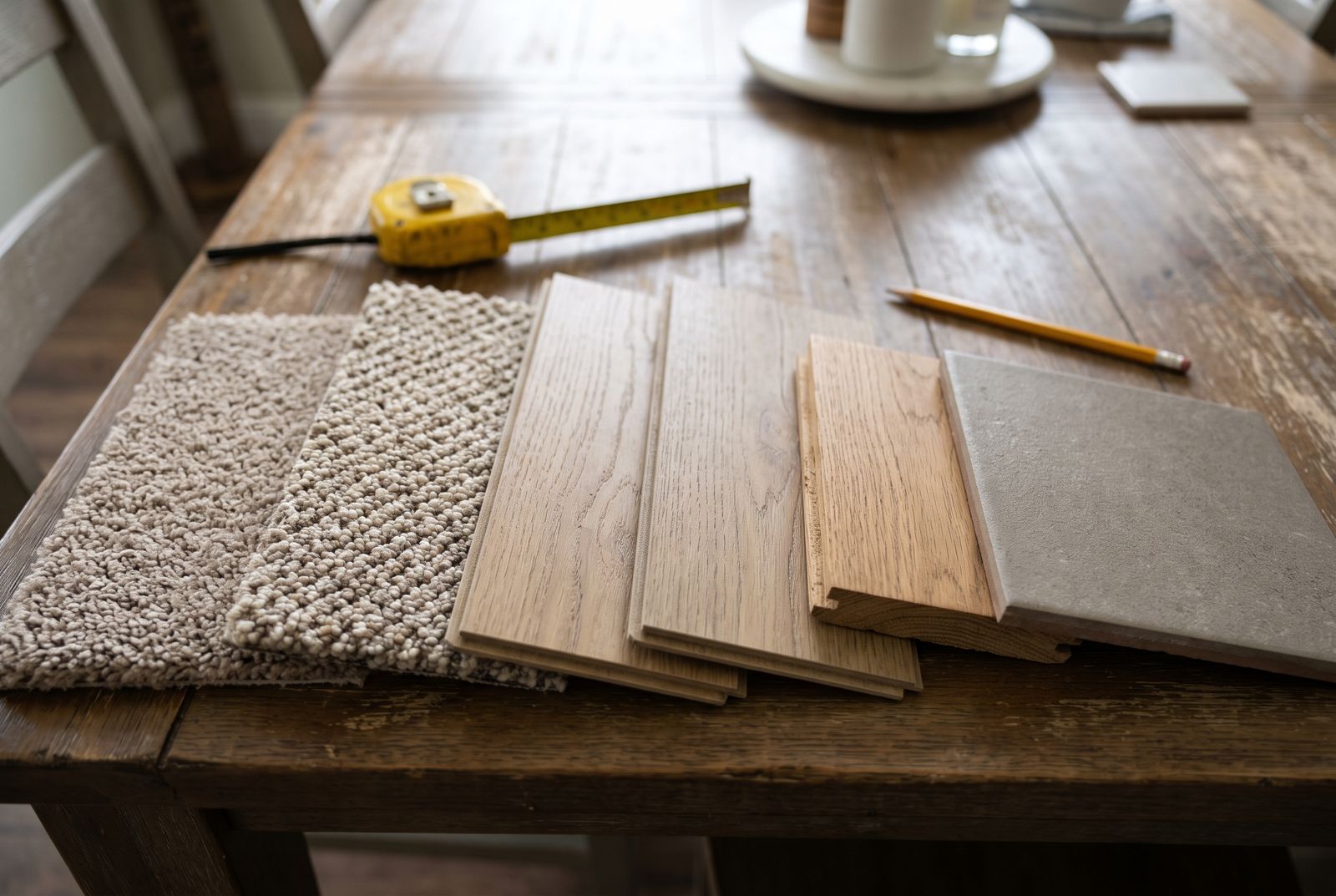
Product names blur together at the store. Underneath the marketing, there are really six families of residential floor, and each behaves in a predictable way.
| Material | Water | Comfort and sound | Wear and repair | Below grade |
|---|---|---|---|---|
| Carpet and pad | Absorbs; spills reach the pad | Warmest and quietest | Wears in lanes; patchable, not refinishable | Only over a dry slab |
| Luxury vinyl plank | Rigid cores sold as waterproof; seams still pass water | Firm; quieter with underlayment | Scratch resistant wear layer; damaged planks can be swapped | Common choice |
| Laminate | Water resistant at best on many; swollen edges do not recover | Firm; can sound hollow without underlayment | Hard surface; cannot be refinished | Check the product rating |
| Engineered hardwood | Tolerates spills wiped quickly | Firm, warmer than tile | Real wood top layer; refinish depends on its thickness | Many are rated for it |
| Solid hardwood | Swells and cups with standing water | Firm, warmer than tile | Can be sanded and refinished several times | Generally not |
| Porcelain or ceramic tile | Unaffected; grout needs sealing | Hard and cold; echoes | Very durable; cracked tiles can be replaced | Yes |
Thickness of the wear layer, not the plank, decides how vinyl and engineered wood wear. On vinyl plank, the clear wear layer is what stands between your floor and grit. On engineered wood, the top layer of real wood decides whether the floor can ever be sanded. Ask for that number when comparing products.
Room by room notes
Bedrooms
Bedrooms see little grit and little water, which is exactly where carpet is at its best. It is warm at 6 a.m., it softens footsteps for whoever sleeps below, and it rarely wears out in a bedroom before it goes out of style. The reasons to switch are specific: a pet that has accidents, a household member with dust allergies, or a strong preference for the look of wood. If you go hard, put a rug where feet land when getting out of bed.
Living and family rooms
These rooms take traffic from every direction, plus drinks, snacks, kids and pets. Wall-to-wall carpet here wears first along the paths between doors and seating. A hard floor with a large rug under the seating area handles that pattern well: the rug takes the lounging, the hard floor takes the traffic, and the rug can be cleaned or replaced on its own. Our rug sizing helper shows what size fits.
Kitchens and baths
Water is the deciding factor. Tile has the longest record in both rooms, and porcelain absorbs less water than standard ceramic. Rigid core vinyl plank is the main alternative and is noticeably softer and warmer to stand on while cooking. In bathrooms, the weak spots for any floating floor are the perimeter at the tub and the toilet flange, so ask how those will be sealed. Carpet in a bathroom, still found in older homes, is the first thing most buyers want gone.
Entries and hallways
Grit tracked in on shoes is the main cause of wear on every floor type: it grinds carpet fiber and scratches finishes. In Atlanta, the red clay that comes in from the yard adds a staining problem on top of the wear. A hard floor at the entry with a washable mat, then carpet further in if you like it, keeps most of that grit and clay out of the carpeted rooms. Narrow hallways are also where carpet seams often fall, which matters when you measure.
Stairs
Stairs are the most labor-intensive surface in the house for any material. Carpet gives grip and softens a misstep, which is why many households with young children or older adults keep it. Hard stairs need a matching stair nose on every tread, and those pieces add cost and time. A runner over wood treads is a common compromise that keeps grip in the middle and wood at the edges.
Basements
Concrete slabs pass moisture from the ground, and that rules out some floors outright. Before choosing, have the slab tested or at least tape a square of plastic sheeting to it for a couple of days and look for condensation underneath. Waterproof vinyl and tile handle damp slabs; carpet can work in a dry basement with synthetic fiber and a moisture resistant pad; solid hardwood is generally not recommended.
Home offices and bonus rooms
Office chairs grind a circle into carpet pile within months and can dent soft wood. Vinyl plank handles rolling chairs well. If you keep carpet, a chair mat solves most of it. Bonus rooms over garages are often colder than the rest of the house, which makes carpet more attractive there.
Choosing floors for Atlanta's climate and houses
Atlanta's humid subtropical climate means long, muggy summers and mild winters, so indoor humidity moves more over a year than it does in drier parts of the country. That movement matters more for some floors than others, and so does what the house sits on. Metro Atlanta has a mix of slab-on-grade houses, homes over vented crawlspaces and, on hilly lots, full or walk-out basements.
How each floor handles Georgia humidity
- Solid hardwood takes on moisture and swells in humid months, then shrinks when the heat runs in winter. Expect some seasonal gaps. Cupping, where board edges rise above the centers, usually points to moisture coming from below. Most wood flooring makers state an indoor humidity range in their installation instructions; running the air conditioning through summer and checking a cheap hygrometer keeps you inside it.
- Engineered wood has a layered core that moves less than solid boards, which is why it is often the wood choice over slabs and in rooms where humidity is harder to control.
- Vinyl plank is not affected by humidity in the same way, which makes it a common pick for Atlanta basements and slab homes. Floating vinyl still expands and contracts with temperature, so it needs the expansion gap its maker specifies, and rooms with strong afternoon sun through large windows deserve a product rated for it.
- Carpet itself copes with humidity, but a pad that stays damp in a basement or over a wet slab can hold musty odor. Synthetic fiber and a moisture-resistant pad are the safer combination below grade.
- Tile on a slab stays cool, which many Atlanta households count as a plus for most of the year.
Slab, crawlspace or basement: test before you choose
On a slab or in a basement, ask the installer how they will test the concrete for moisture. The two common methods are a calcium chloride test, which measures moisture coming off the surface over a few days, and an in-situ relative humidity probe set into holes drilled in the slab. Flooring makers publish the limits their products can tolerate, and a test result is what keeps a warranty claim from turning into an argument. The plastic sheet test in the basement notes above is a useful early warning, not a replacement.
Over a crawlspace, the moisture comes from the ground under the house. Before new hardwood goes in, look for a plastic vapor barrier covering the soil, standing water, and damp or stained joists. A wet crawlspace is one of the more common reasons a new wood floor cups in its first Georgia summer, and it is cheaper to fix before the floor is down.
Tracked-in red clay and spring pollen both favor a hard floor at the doors and carpet further in. Neither is a reason to rip carpet out of bedrooms by itself; walk-off mats and a good vacuum do most of the work.
Mixing floors without awkward edges
Most homes end up with more than one floor type, and the trouble spots are where they meet. Carpet and pad together are often taller than a floating plank, so a doorway between them needs a transition piece chosen for the height difference. Plan transitions under doors, not in the middle of open spaces. Where an open plan makes that impossible, keep the same hard floor running through and use rugs to define zones.
- If rooms connect through an open planrun one hard floor through and add rugs.
- If bedrooms open off a hallwaycarpet in bedrooms, transition at each door.
- If you live in a condo or apartmentcheck the association's sound rules before any hard floor.
- If you plan to sell within a few yearsask a local agent what buyers expect in each room.
Questions about switching floors
Is LVP really waterproof?
Many rigid core vinyl planks are sold as waterproof, which means the plank itself is not damaged by water. Water can still run through the joints and edges to the subfloor below, where it can cause mold or damage. Treat "waterproof" as spill-tolerant, not as a substitute for fixing leaks.
Which is quieter, carpet or hard flooring?
Carpet over pad absorbs both footstep noise and room echo better than any hard surface. On upper floors, a hard floor with a sound-rated underlayment narrows the gap. Many condo associations set minimum sound ratings for flooring, so check your rules before choosing.
Can I put hardwood in a basement?
Solid hardwood is generally not recommended below grade because concrete slabs pass moisture. Many engineered wood products are rated for basements when installed to their instructions, and waterproof vinyl and tile are the usual choices.
Is carpet bad for allergies?
Carpet holds dust and allergens until they are vacuumed out, while hard floors let them settle on the surface where they are easy to see and remove. Some people with allergies do better with hard floors and washable rugs. Frequent vacuuming with a sealed, HEPA filtered vacuum matters with either.