
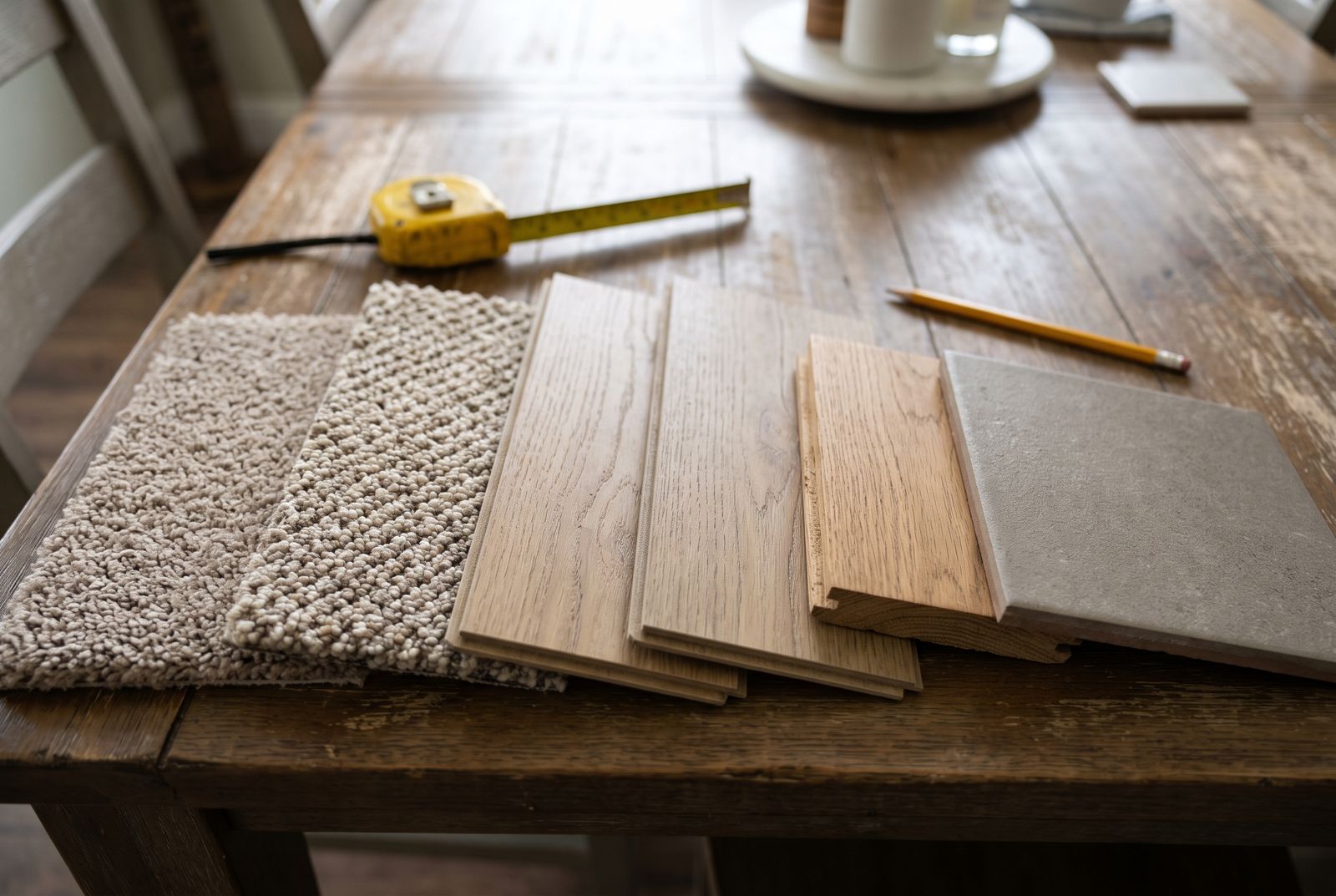
The best entryway flooring for an Atlanta winter is whatever can take standing water, grit and red clay in the first few steps inside the door, then hand off to carpet at a point where shoes are already mostly dry. Cold rain, wet leaves and clay tracked in from the yard all land in the same small area, so it makes sense to plan that area from the door inward rather than choosing one floor for the whole room and hoping the entry copes.
Start outside, because the water arrives there first
Before you choose anything for inside, look at what is pushing water toward the threshold. A floor rated for wet areas can still fail if rain runs under the door every storm.
- Is there an overhang or porch roof, or does rain hit the door directly?
- Does the stoop or walkway slope away from the house? Puddles sitting against the sill will find any gap.
- Do the gutters above the entry overflow when leaves clog them in late fall?
- Are the door sweep and weatherstripping intact? Daylight under a closed door means they aren't.
- Is the house on a slab or over a crawlspace? A crawlspace entry puts a wood subfloor right under the wettest spot in the house.
Fixing a leaking sill or a clogged gutter is far less disruptive than replacing a floor that soaked up water from underneath. If water has already been getting in, lift a corner of the existing flooring before you shop and check the subfloor for dark staining or soft spots.
Get the threshold height right before picking a material
The threshold is where new flooring most often causes a problem nobody planned for. A new floor plus its underlayment can sit higher than the old one, and an inward-swinging exterior door may no longer clear it. Measure from the subfloor to the bottom of the door and compare that with the total build-up of the material you're considering; if the door will need trimming, plan it before installation day. Tile set over backer board, for example, adds more height than a click-together vinyl plank.
Look at how the new floor will meet the exterior threshold, too. The flooring should finish tight to the threshold with a clean, closed edge, not an open gap where water and grit collect. Floating floors such as luxury vinyl plank need an expansion space around the perimeter. The manufacturer's installation instructions say how wide it should be and what may fill it at an exterior door, so follow them exactly.
Choose the first six feet for water and grit, not looks alone
The first few steps inside take nearly all of the wet and nearly all of the grit. Georgia's red clay is the hard part: it's fine-grained, it stains, and once it dries it acts like sandpaper on soft finishes. Wet leaves can leave tannin marks and carry water further in than you'd expect. Here is how the common choices handle that zone.
| Material | Standing water | Red clay and grit | Grip with wet shoes | Worth knowing |
|---|---|---|---|---|
| Porcelain tile | Tile face is unaffected; grout is the weak point | Wipes off the tile; can stain pale, unsealed grout | Varies widely by finish | Cold underfoot. Darker or sealed grout suits clay country. |
| Luxury vinyl plank | Surface sheds water; seams and edges can let it reach the subfloor | Grit scratches the wear layer over time | Textured surfaces grip better than smooth ones | Compare wear layer thickness between products. |
| Hardwood (solid or engineered) | Handles quick wipe-ups; water left sitting can cup or stain boards | Grit dulls and scratches the finish | Can be slick | Workable if you dry it promptly and expect the entry to need refinishing first. |
| Laminate | Many cores swell if water sits on the seams | Hard surface resists scratching | Often slick | Riskiest at an exterior door unless the product is specifically rated for water. |
| Carpet | Absorbs water into pile and pad | Clay can stain, especially light colors | Good | Better a few steps back from the door than at it. |
For tile, slip resistance deserves as much attention as color. Manufacturers publish a wet dynamic coefficient of friction (DCOF) and, under the ANSI A326.3 standard, a classification for where the tile is suitable to use. Choose one classified for interior areas that get wet. Polished porcelain looks sharp in a showroom photo but is a poor match for a spot where people step in with wet soles.
The first six feet should be the floor you'd least mind mopping twice a day in January.
Decide where the hard floor stops and the carpet starts
Carpet should begin where shoes have stopped dripping. In practice that means placing the change of material where it is both far enough in and visually sensible.
- A doorway or wall line makes the cleanest break. A transition across the middle of an open floor is more visible and easier to catch a toe on.
- If the front door opens straight into a carpeted living room, either mark out a rectangular hard-floor landing that lines up with the door and a nearby wall, or reconsider carpet for that room. Our guide to choosing carpet or hard flooring room by room walks through that trade-off.
- Carpet over pad usually stands taller than vinyl plank, so plan how the two heights will meet before you order.
- Near the entry, multicolored or warm mid-tone carpet hides traces of clay far better than pale solids.
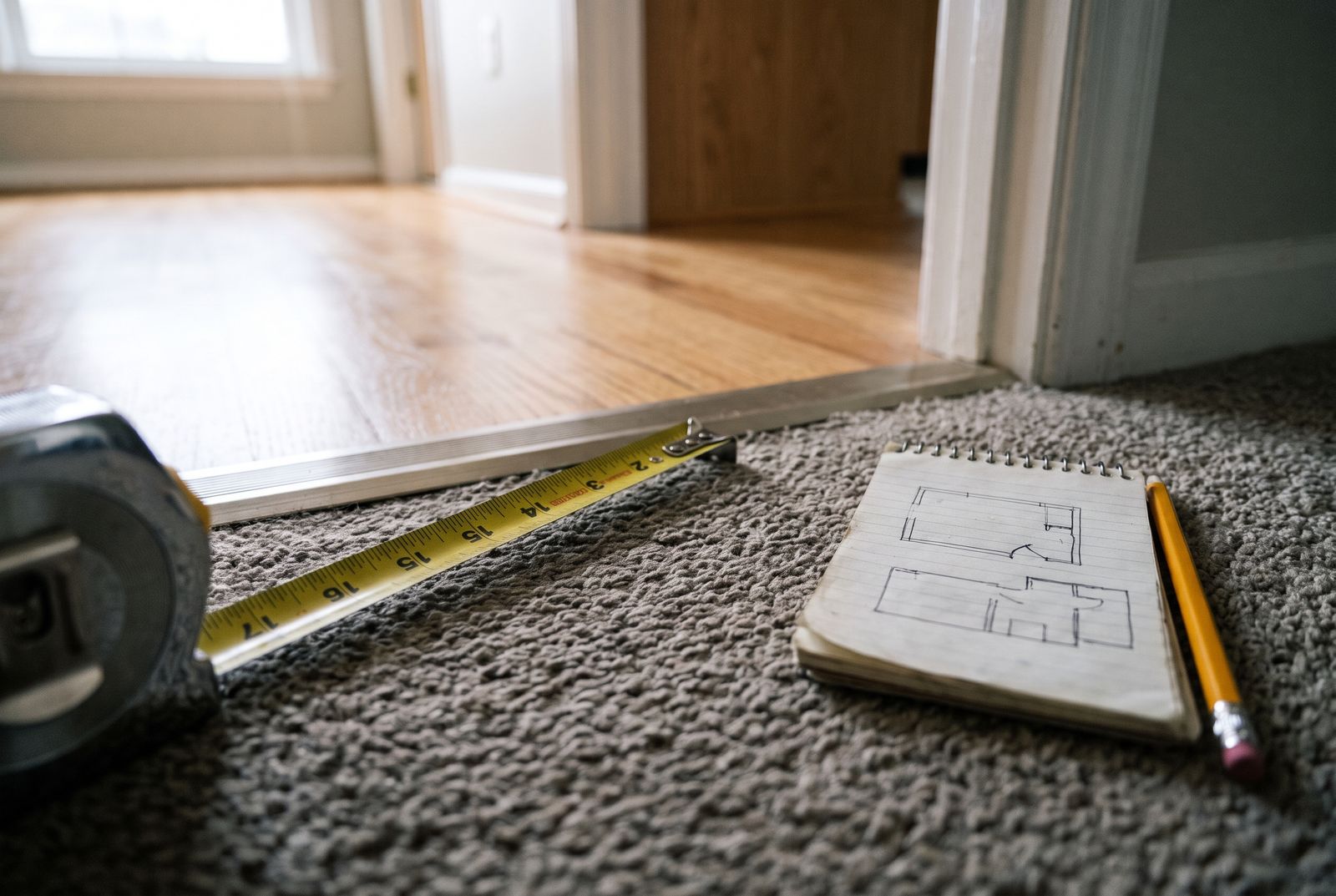
Sketch the landing with its dimensions before you ask for quotes, since its size drives how much of each material you need and where any cuts fall. The steps in how to measure for new carpet and flooring apply here, with one extra note: measure the landing from the inside face of the threshold, not from the door itself.
Match the entry to who comes through the door
The right depth and material for the landing depend more on the household than on the house.
- If dogs come in from a wet yardmake the hard-floor landing deep enough for them to stand and shake, and choose textured vinyl plank or porcelain over a soft wood finish.
- If kids come home from muddy practicefavor porcelain with dark or sealed grout, run to the spot where shoes actually come off.
- If everyone takes shoes off at the doorthe landing only needs to cover the shoe-removal spot plus a step, so carpet can start closer.
- If someone in the home is unsteady on their feetput wet traction and a flush transition ahead of appearance, and avoid polished tile and raised edges.
- If the entry sits over a crawlspace and water has come in at the sill beforefix the source and check the subfloor before choosing any floating floor.
Stop water at the door, set the threshold height before choosing a material, put the most water-tolerant floor in the first few steps, and start carpet only where shoes are dry.
When you're ready to price it, use the project inquiry form and include which way the door swings, what the floor is now, what it meets inside, and who uses that door most. Those four details shape the answer more than square footage does, and you'll get a reply by email.