
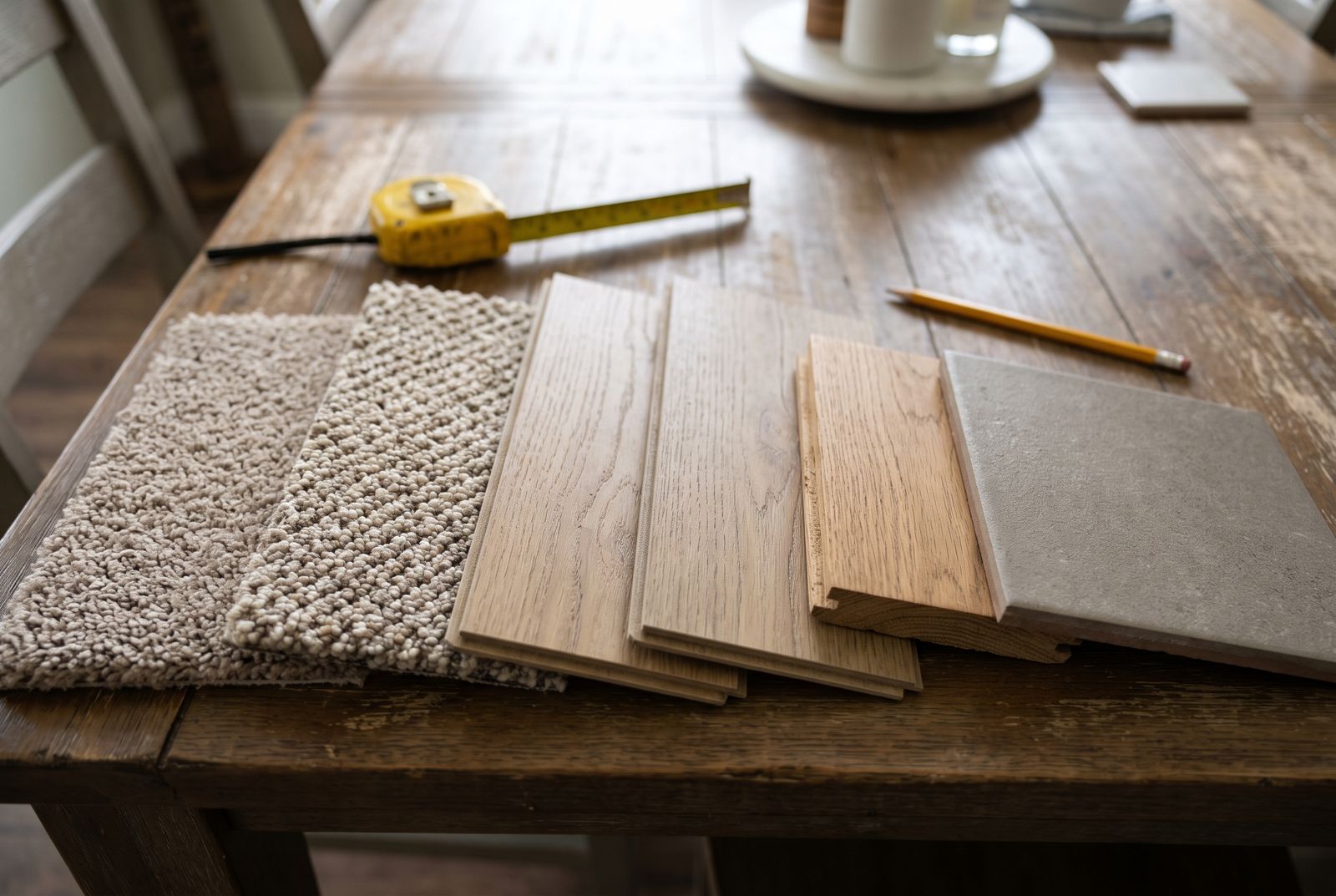
The pad under your carpet decides much of how the floor feels and how well the carpet holds its shape over the years. This is the season people notice it: once the heat comes on in Atlanta, a carpeted room over a concrete slab or a drafty crawlspace can still feel cool and hard at the feet, and a thin or worn-out pad is often part of the reason.
What carpet padding does under the carpet
Carpet padding (the trade usually calls it cushion) sits between the carpet backing and the subfloor. It absorbs the impact of footsteps so the carpet doesn't grind against plywood or concrete. It adds a layer of insulation, it softens sound, especially between floors, and it gives the carpet its feel, from firm to sink-in soft.
When a pad breaks down, the carpet shows it. Traffic lanes flatten, the floor feels hard in spots, and ripples can appear because the backing is flexing more than it was built to. If you're seeing those signs, our guide on when to replace carpet and when a repair is enough helps you sort out whether the pad, the carpet or both are the problem.
Rebond, foam, rubber and fiber pads side by side
Most residential pads fall into four families. Within each one, quality varies a lot, so the type alone doesn't tell you whether a pad is good.
| Pad type | What it is | How it feels | Where it tends to fit | Watch for |
|---|---|---|---|---|
| Rebond | Scraps of urethane foam bonded into a sheet, with a flecked, multicolored look | Medium to firm, depending on density | Bedrooms, living rooms and most general residential use | Low-density rebond compresses and wears out faster |
| Frothed or memory foam | Urethane foam made as one solid sheet; memory foam recovers slowly after pressure | Soft and cushioned, with a sink-in feel for memory foam | Low-traffic bedrooms where softness matters most | Can be softer or thicker than the carpet's specification allows |
| Rubber | Flat (slab) rubber or waffle rubber with a ribbed underside | Firm with some spring | Busy rooms where long support matters | Waffle styles can flatten over time; heavy to handle |
| Fiber (felt) | Pressed synthetic, jute, wool or recycled fibers | Thin, firm, little bounce | Berber and other loop carpets, and places that need a low profile | Feels hard to anyone expecting foam |
Berber and other loop styles usually need a thin, firm cushion. A thick, soft pad lets the backing flex with every step, which can strain seams and pull loops. Loop carpet makers commonly spell out the cushion they expect, so read that before choosing anything plush.
Density and thickness measure different things
Thickness is simply how tall the pad is, given in fractions of an inch. Density is how much material is packed into it, usually stated in pounds per cubic foot for foam pads. Some rubber and fiber pads are described by weight per square yard instead. A pad can be thick and light, or thin and dense, and those two pads will behave very differently.
Thick, low-density pads feel luxurious on a sample square. Under real traffic they compress, and the extra height lets the carpet flex too much. That flexing stretches the backing and can lead to ripples and opened seams. A denser pad at a moderate thickness usually supports the carpet better for longer.
A pad that feels plush on a sample is not the same as a pad that will still be holding up the carpet years from now.
- If the room takes heavy traffic, like a hallway or family room,favor density over thickness and stay within the carpet maker's thickness limit.
- If the carpet is a berber or other loop style,use the thin, firm cushion its manufacturer specifies.
- If it's a quiet bedroom and softness is the goal,a frothed or memory foam pad can work, as long as the carpet's specification permits it.
- If the carpet goes on stairs,choose a firm, dense pad, since a very soft one can make treads feel less stable underfoot.
- If the floor is a concrete slab,ask whether the pad or the installation calls for a moisture barrier.
Cold floors over a slab or crawlspace
A pad adds resistance to heat flow, and pad makers often publish an R-value for their products. More material generally means more insulation, which is why a better pad can make a slab room feel warmer at the feet. It is a modest improvement, though, and it has limits.
Over a crawlspace, a cold floor often traces back to what's below: missing or sagging insulation between the floor joists, or outside air moving through the crawlspace. No pad fixes that, so it's worth a look underneath before blaming the carpet. Over a slab, concrete stays cool and can pass moisture upward, so the carpet and pad instructions will say what they expect on concrete, including whether a barrier is needed.
Homes with radiant floor heat are the opposite case. There you want less insulation, not more, and the heating system and carpet makers usually set a limit on how much the pad and carpet can resist heat. If you're still deciding whether a slab or basement room should be carpeted at all, our room-by-room comparison of carpet, LVP, hardwood and tile lays out the trade-offs.
Check the carpet maker's cushion requirements first
Carpet manufacturers state the cushion their carpet needs, typically a minimum density or weight and a maximum thickness. Putting the carpet over a pad outside those limits can void the carpet warranty. Many warranties also expect new cushion rather than reused pad.
Ask for the carpet's specification sheet or warranty document and find the cushion section before you choose a pad. The Carpet and Rug Institute also publishes general cushion guidance, but the carpet maker's own requirements are the ones that govern the warranty. A quote that simply says "pad included" doesn't tell you whether that pad meets them.
What to ask before you buy a pad
- What type of pad is this, and what are its density (or weight) and thickness?
- Does it meet the cushion requirements in this carpet's warranty, and can I see that in writing?
- Does it have an attached moisture barrier, and does this room need one?
- Is the same pad going in every room, or does it change for stairs, a basement or a slab room?
- Is all the old pad being replaced, including in closets and on stairs?
- If it's memory foam or a thick foam, is it still within the carpet's thickness limit?
When you describe your project on the project inquiry form, include the carpet style you're considering and whether each room sits on a slab, over a crawlspace or upstairs, since each one changes which pad makes sense.